Rationalization: III
Simple is not enough
Any closed market can be reproduced by an Arrow–Debreu economy of homothetic consumers with single-good endowments [1]. But the construction in [1] is simply of theoretical interest. The remaining question is, for a given market demand function $\mathbf{d}$, can it be reproduced by finitely many simple consumers? That is,
Question. Fix one homothetic Arrow–Debreu economy with aggregate demand $\mathbf{d}: \Delta_n \mapsto \mathbb{R}_+^n$. Can we construct a market with $T$ simple consumers, so that the aggregate demand function is close to the original economy:
$$\mathrm{diag}(\mathbf{p})\, \mathbf{d}(\mathbf{p}) \approx \mathbf{h}(\mathbf{p}) = \textstyle\sum_{t=1}^T w_t(\mathbf{p})\, \boldsymbol{\gamma}_t(\mathbf{p}), \quad \boldsymbol{\gamma}_t: \Delta_n \mapsto \Delta_n.$$
Here $w_t(\mathbf{p})$ is the wealth of consumer $t$ at price $\mathbf{p}$ and $\boldsymbol{\gamma}_t(\mathbf{p})$ is the expenditure-share function of consumer $t$. We compare the expenditure instead of the demand to normalize the quantity onto the $n$-dimensional simplex $\Delta_n$. We may write the expenditure share as $\boldsymbol{\gamma}_t(\mathbf{p})$Strictly speaking we should write $\boldsymbol{\gamma}_t(\mathbf{p}, w_t)$, since there can be a wealth effect. because homothetic preferences suffice.
A more aggressive question is,
Question 1. Can we use only CES consumers? That is, we restrict $\boldsymbol{\gamma}_t \in \mathcal{H}_{\mathrm{CES}}$,
$$\mathcal{H}_{\mathrm{CES}} = \big\{\, \boldsymbol{\gamma}: \Delta_n \mapsto \Delta_n \mid \boldsymbol{\gamma}(\mathbf{p}) = \mathrm{softmax}(\mathbf{y} - \sigma \log \mathbf{p}), \ \sigma \in (-1, \infty) \,\big\}.$$
Answer. We define simple to be those who produce expenditure shares with bounded total variation. Clearly $\mathcal{H}_{\mathrm{CES}}$ belongs to this case because it is monotone. We show that:
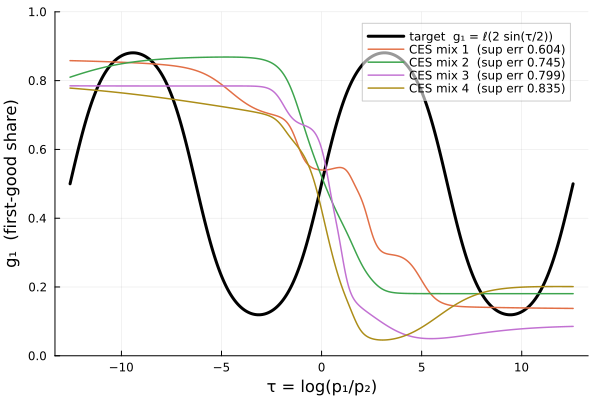
- There is a $2$-good, $1$-agent economy whose expenditure share has unbounded total variation.
- If we use consumers with bounded total variation, there is a lower bound on the difference,
$$\inf_{\mathbf{h}}\ \sup_{\mathbf{p}\in \mathrm{int}\,\Delta_n}\ \|\mathbf{h} - \mathrm{diag}(\mathbf{p})\mathbf{d}\|_\infty\ \ge\ 0.3808.$$
The same holds even if we use high-order wealth functions. The bound is tight when $\mathbf{h}$ is composed of $T$ Cobb–Douglas consumers.
Preliminaries: elasticity and total variation
Two-good economy.
For two goods, a homothetic agent's demand depends on price only through the relative log price. Writing $\mathbf{x}$ for the demanded bundle, the quantity ratio $r_x$ and the expenditure-share ratio $r_\gamma$ are functions of
$$\tau(\mathbf{p}) := \log\tfrac{p_1}{p_2}, \quad r_x(\tau) := \tfrac{x_1}{x_2}, \quad r_\gamma(\tau) := \tfrac{\gamma_1(\tau)}{\gamma_2(\tau)} = \exp(\tau)\, r_x(\tau). \tag{1}$$
Write $\ell$ for the logistic map, so that $\gamma_1 = \ell(\log r_\gamma)$:
$$\ell(z) := \tfrac{\exp(z)}{1+\exp(z)}.$$
The elasticity of substitution is defined locally by
$$1+\sigma(\tau) := -\tfrac{\mathrm{d}\log r_x(\tau)}{\mathrm{d}\tau}. \tag{2}$$
Combining $(1)$ and $(2)$, $\log r_\gamma(\tau) = \tau + \log r_x(\tau)$ differentiates to
$$\tfrac{\mathrm{d}\log r_\gamma(\tau)}{\mathrm{d}\tau} = \tfrac{\gamma_1'(\tau)}{\gamma_1(1-\gamma_1)} = -\sigma(\tau), \qquad 1+\sigma(\tau)\ge0,$$
where the logistic factor uses $\gamma_1 = \ell(\log r_\gamma)$. So a homothetic two-good agent is a variable-elasticity agent ($\sigma(\tau)\ge-1$ arbitrary).
Total variation.
For $f:\mathcal{I}\mapsto\mathbb{R}$ on an interval $\mathcal{I}\subseteq\mathbb{R}$, let $\mathrm{TV}_\mathcal{I}(f)$ be the total variation of $f$ on $\mathcal{I}$, and write $\mathrm{TV}(f) := \mathrm{TV}_\mathbb{R}(f)$. We have the following properties; see Folland [2] (§3.5).
$$\mathrm{TV}_\mathcal{I}(f) = \sup_{S_m} \textstyle\sum_{j=1}^m |f(\tau_j)-f(\tau_{j-1})|.$$
Moreover,(1) If $f$ is absolutely continuous, then $\mathrm{TV}_\mathcal{I}(f) = \int_\mathcal{I} |f'(\tau)|\,\mathrm{d}\tau$.
(2) If $f$ is monotone, then $\mathrm{TV}_\mathcal{I}(f) = \sup_\mathcal{I} f - \inf_\mathcal{I} f$; if further $f$ is valued in $[0,1]$, then $\mathrm{TV}_\mathcal{I}(f) \le 1$.
(3) $\mathrm{TV}(af) = |a|\,\mathrm{TV}(f)$, $\ \mathrm{TV}(f+g) \le \mathrm{TV}(f) + \mathrm{TV}(g)$, $\ \mathrm{TV}(\textstyle\sum_k \lambda_k f_k) \le \textstyle\sum_k \lambda_k \mathrm{TV}(f_k)$ for $\lambda_k \ge 0$.
(4) If $f_m \to f$ pointwise, then $\mathrm{TV}(f) \le \liminf_m \mathrm{TV}(f_m)$.
For a two-good economy, we only have to consider the share of the first good, $\gamma_{t1}$. That is, we assume each consumer satisfies
$$\mathrm{TV}(\gamma_{t1})\le G.$$
$$\gamma_1^{\mathrm{lin}}(\tau) = \begin{cases} 1, & \tau \le \log\tfrac{a_1}{a_2}, \\ 0, & \tau > \log\tfrac{a_1}{a_2}, \end{cases}$$
with the tie value arbitrary. Clearly $\mathrm{TV}(\gamma_1^{\mathrm{lin}})=1$.The example with $\mathrm{TV}=\infty$. In the following one-agent example, the market share $\mathbf{g}$ is just the agent's own expenditure share $\boldsymbol{\gamma}$.
Expenditure share of Example 3. The red dots are a numerical cross-check by quadrature and automatic differentiation.
$$r_x(\tau) := \exp\!\left(-\tau + 2\sin(\tfrac\tau2)\right).$$
Then it can be rationalized by the utility$$u(x_1,x_2) := x_2\,\phi\!\left(\tfrac{x_1}{x_2}\right), \quad \text{where} \quad \log\phi(\rho) := \int_1^\rho \tfrac{\mathrm{d}s}{s + \exp(-r_x^{-1}(s))} < \infty. \tag{3}$$
Furthermore,(1) $u$ is homogeneous of degree one, increasing, and concave.
(2) The expenditure share has log-odds
$$\log\tfrac{g_1(\tau)}{g_2(\tau)} = 2\sin(\tfrac\tau2). \tag{4}$$
Thus $\mathrm{TV}(g_1) = \infty$.We first verify that the integral is well-defined. The exponent $\log r_x(\tau) = -\tau + 2\sin(\tfrac\tau2)$ has derivative $\cos(\tfrac\tau2)-1\le0$, so $r_x$ is a strictly decreasing continuous bijection from $\mathbb{R}$ onto $(0,\infty)$, and $r_x^{-1}$ is defined and continuous on $(0,\infty)$. The integrand $s\mapsto[s+\exp(-r_x^{-1}(s))]^{-1}$ is therefore continuous on $(0,\infty)$. It satisfies $0 < [s+\exp(-r_x^{-1}(s))]^{-1} \le \tfrac1s$, so for any $\rho>0$,
$$|\log\phi(\rho)| = \left|\int_1^\rho \tfrac{\mathrm{d}s}{s + \exp(-r_x^{-1}(s))}\right| \le \left|\int_1^\rho \tfrac{\mathrm{d}s}{s}\right| = |\log\rho| < \infty,$$
so the integral in $(3)$ is finite and $\log\phi(\rho)$ is well-defined.
Part (1). Homogeneity is immediate from $(3)$. Let
$$\rho := \tfrac{x_1}{x_2}, \quad D(\rho) := \rho + \exp(-r_x^{-1}(\rho)) > \rho,$$
so that $(3)$ reads $\tfrac{\phi'(\rho)}{\phi(\rho)} = \tfrac{1}{D(\rho)}$. With $\partial_{x_1}\rho = 1/x_2$ and $\partial_{x_2}\rho = -\rho/x_2$, differentiating $u = x_2\phi(\rho)$ gives
$$\begin{align*} u'_1 &= x_2\phi'(\rho)\,\partial_{x_1}\rho = \phi'(\rho), \\ u'_2 &= \phi(\rho) + x_2\phi'(\rho)\,\partial_{x_2}\rho = \phi(\rho)-\rho\phi'(\rho) = \phi(\rho)\tfrac{D(\rho)-\rho}{D(\rho)}, \end{align*} \tag{5}$$
both positive (since $\phi>0$ and $D(\rho)>\rho$), so $u$ is increasing, with marginal rate of substitution
$$\tfrac{u'_1}{u'_2} = \tfrac{\phi'(\rho)}{\phi(\rho)-\rho\phi'(\rho)} = \exp(r_x^{-1}(\rho)). \tag{6}$$
For concavity we show $\phi$ is concave; then $u(x_1,x_2)=x_2\phi(x_1/x_2)$, its perspective, is concave for $x_2>0$. Since $r_x^{-1}$ is decreasing, $\exp(-r_x^{-1}(\rho))$ is increasing, so $D(\rho)-\rho = \exp(-r_x^{-1}(\rho))$ is increasing and $\mathrm{d}D \ge \mathrm{d}\rho$ as Stieltjes measures. From $\phi' = \phi/D$ we have $\log\phi' = \log\phi - \log D$, so for $0<a<b$, using $(\log\phi)' = 1/D$ and $\mathrm{d}\log D = \mathrm{d}D/D$,
$$\log\tfrac{\phi'(b)}{\phi'(a)} = \int_a^b \tfrac{\mathrm{d}\rho}{D(\rho)} - \int_{(a,b]}\tfrac{\mathrm{d}D(\rho)}{D(\rho)} \le 0,$$
since $\mathrm{d}D \ge \mathrm{d}\rho$ and $D>0$. Hence $\phi'$ is nonincreasing, $\phi$ is concave, and so is $u$.
Part (2). Since $u$ is increasing, the budget must bind, so the KKT condition for utility maximization reads
$$-\nabla u + \lambda \mathbf{p} = 0 \quad\Longleftrightarrow\quad \tfrac{u'_1}{u'_2} = \tfrac{p_1}{p_2} = \exp(\tau).$$
By $(6)$ this is $\exp(r_x^{-1}(\rho)) = \exp(\tau)$, so $\rho = r_x(\tau)$ and the optimizer is
$$x_1(\mathbf{p},w) = \tfrac{w\, r_x(\tau)}{p_1 r_x(\tau)+p_2}, \quad x_2(\mathbf{p},w) = \tfrac{w}{p_1 r_x(\tau)+p_2}.$$
Then
$$\tfrac{g_1(\tau)}{g_2(\tau)} = \tfrac{p_1x_1}{p_2x_2} = \exp(\tau)\,r_x(\tau) = \exp\!\left(2\sin(\tfrac\tau2)\right),$$
which gives the log-odds $(4)$. Inverting the logistic map, $g_1(\tau) = \ell!\left(2\sin(\tfrac\tau2)\right)$. This share oscillates between $\ell(-2)$ and $\ell(2)$ every $4\pi$ units of log-price. On the partition $S_{2N}$ with $\tau_j = \pi + 2\pi j$, $j = 0, \ldots, 2N$, the identity $2\sin(\tfrac{\tau_j}{2}) = 2(-1)^j$ gives $g_1(\tau_j) = \ell(2(-1)^j)$, so consecutive values alternate between $\ell(2)$ and $\ell(-2)$ and
$$\textstyle\sum_{j=1}^{2N} |g_1(\tau_j)-g_1(\tau_{j-1})| = 2N\left(\ell(2)-\ell(-2)\right),$$
which diverges as $N\to\infty$. Hence $\mathrm{TV}(g_1)=\infty$.
The role of wealth functions
It is not hard to imagine that there will be a gap if the ground truth is like Example 3. While we fix, for any $t \in [T]$, a bounded-$\mathrm{TV}$ share, can we resolve this by playing with the wealth function $w_t(\mathbf{p})$, so that a mixture of bounded ones recovers the unbounded example?
Let us consider positive Bernstein wealth functions: each agent's wealth $w_t$ is a nonnegative combination of the degree-$q$ Bernstein basis in the price of the first good $p_1 = \ell(\tau)$ (a subclass of the nonnegative degree-$q$ polynomials). That is, $w_t \in \mathcal{B}^q$, defined by
$$\begin{align*} \hat{w}_k(\tau) & := B_k^q(p_1(\tau)), \qquad B_k^q(s) := \tbinom{q}{k}s^k(1-s)^{q-k}, \quad k=0,\ldots,q, \\ w_t(\mathbf{p}) & := \textstyle\sum_{k=0}^q c_{t,k}\, \hat{w}_k(\tau), \qquad c_{t,k}\ge0. \end{align*}$$
Feasibility (total wealth $1$) and the partition of unity (Lemma 2(1)) force $\textstyle\sum_t c_{t,k}=1$ for every $k$, so the expenditure share regroups from a sum over the $T$ agents into a sum over the $q+1$ weights,
$$h_1 = \textstyle\sum_{t=1}^T w_t(\mathbf{p})\,\gamma_{t1} = \textstyle\sum_{k=0}^q \hat{w}_k(\tau)\,\hat g_{k1}, \qquad \hat g_{k1} := \textstyle\sum_t c_{t,k}\,\gamma_{t1}. \tag{7}$$
For each $k$, $\hat g_{k1}$ is a convex combination of the base shares $\gamma_{t1}$ with the constant weights $c_{t,k}$, hence $\mathrm{TV}(\hat g_{k1})\le G$ by Lemma 1(3). We need the following result for the Bernstein basis.
(1) $\textstyle\sum_{k=0}^q B_k^q(s) = 1$.
(2) $(B_k^q)'(s) = q\left(B_{k-1}^{q-1}(s) - B_k^{q-1}(s)\right)$, with out-of-range terms zero.
(3) $\int_0^1 \textstyle\sum_{k=0}^q |(B_k^q)'(s)|\,\mathrm{d}s \le 2q$.
Statements (1) and (2) are standard. For (3) we note $\textstyle\sum_{k=0}^q |(B_k^q)'(s)| \le q\textstyle\sum_{k=0}^q\left(B_{k-1}^{q-1}(s)+B_k^{q-1}(s)\right) = 2q$; integrating over $[0,1]$ gives the bound.
$$\mathrm{TV}(h_1)\le q + (q+1)G,$$
independently of the number of agents.We argue directly from the partition definition of total variation, so the base shares $\hat g_{k1}$ need only be of bounded variation (the weights $\hat{w}_k$ are smooth). Fix a partition $S_m = {\tau_0<\cdots<\tau_m}$ and write $\Delta_j f := f(\tau_j)-f(\tau_{j-1})$. Since $\textstyle\sum_k\hat{w}_k\equiv1$ by Lemma 2(1), $\textstyle\sum_k\Delta_j\hat{w}_k = 0$. Summation by parts on $(7)$ gives
$$\begin{align*} \Delta_j h_1 &= \textstyle\sum_{k=0}^q \left[\hat{w}_k(\tau_j)\,\Delta_j\hat g_{k1} + \hat g_{k1}(\tau_{j-1})\,\Delta_j\hat{w}_k\right] \\ &= \textstyle\sum_{k=0}^q \hat{w}_k(\tau_j)\,\Delta_j\hat g_{k1} + \textstyle\sum_{k=0}^q\left(\hat g_{k1}(\tau_{j-1})-\tfrac12\right)\Delta_j\hat{w}_k, \end{align*}$$
the second line subtracting $\tfrac12\textstyle\sum_k\Delta_j\hat{w}_k = 0$. Since $0\le\hat{w}_k\le1$ and $|\hat g_{k1}-\tfrac12|\le\tfrac12$,
$$|\Delta_j h_1| \le \textstyle\sum_{k=0}^q |\Delta_j\hat g_{k1}| + \tfrac12\textstyle\sum_{k=0}^q |\Delta_j\hat{w}_k|.$$
Summing over $j$ and taking the supremum over partitions,
$$\mathrm{TV}(h_1) \le \textstyle\sum_{k=0}^q \mathrm{TV}(\hat g_{k1}) + \tfrac12\textstyle\sum_{k=0}^q \mathrm{TV}(\hat{w}_k).$$
Each $\hat g_{k1}$ satisfies $\mathrm{TV}(\hat g_{k1})\le G$, so the first sum is at most $(q+1)G$. The weights $\hat{w}_k = B_k^q(p_1(\tau))$ are absolutely continuous, and since $p_1=\ell(\tau)$ is monotone onto $(0,1)$, the change of variables $s=p_1$ with Lemma 2(3) gives
$$\textstyle\sum_{k=0}^q\mathrm{TV}(\hat{w}_k) = \int_\mathbb{R}\textstyle\sum_{k=0}^q |\hat{w}_k'(\tau)|\,\mathrm{d}\tau = \int_0^1\textstyle\sum_{k=0}^q |(B_k^q)'(s)|\,\mathrm{d}s \le 2q.$$
Therefore $\mathrm{TV}(h_1)\le (q+1)G + q$.
So the Fisher and Arrow–Debreu markets are only special cases.
- $q=0$ (Fisher). The only basis function is $B_0^0\equiv1$, so $\hat{w}\_0\equiv1$ and the wealth $w_t = c_{t,0}$ is a price-independent constant (fixed budget). Then $h_1 = \textstyle\sum_t c_{t,0}\gamma_{t1}$, giving the Fisher bound $\mathrm{TV}(h_1)\le G$.
- $q=1$ (Arrow–Debreu). The basis is $B_0^1(s)=1-s$ and $B_1^1(s)=s$, so with $s=p_1$ and $p_1+p_2=1$ on $\Delta_2$ the weights are $\hat{w}\_0 = p_2$, $\hat{w}\_1 = p_1$, and the wealth
$$w_t = c_{t,0}p_2 + c_{t,1}p_1 = \langle \mathbf{p}, \mathbf{b}_t \rangle, \qquad \mathbf{b}_t = (c_{t,1}, c_{t,0}),$$
is the value of the endowment $\mathbf{b}\_t$. Then $h_1 = \textstyle\sum_t \langle \mathbf{p}, \mathbf{b}\_t \rangle\,\gamma_{t1}$, giving the Arrow–Debreu bound $\mathrm{TV}(h_1)\le 2G+1$.
The lower bound
$$\sup_{\tau\in\mathbb{R}}|f(\tau)-h(\tau)| \ge \tfrac{1}{2m} \max\left\{ \textstyle\sum_{j=1}^m |f(\tau_j)-f(\tau_{j-1})| - C,\ 0 \right\}. \tag{8}$$
Bounding each pointwise gap $|f(\tau_i)-h(\tau_i)|$ by $\sup_{\tau}|f(\tau)-h(\tau)|$, for each adjacent pair,
$$\begin{align*} |f(\tau_j)-f(\tau_{j-1})| &\le |h(\tau_j)-h(\tau_{j-1})| + |f(\tau_j)-h(\tau_j)| + |f(\tau_{j-1})-h(\tau_{j-1})| \\ &\le |h(\tau_j)-h(\tau_{j-1})| + 2\sup_{\tau}|f(\tau)-h(\tau)|. \end{align*}$$
Summing over $S_m$ gives
$$\begin{align*} \textstyle\sum_{j=1}^m |f(\tau_j)-f(\tau_{j-1})| &\le \textstyle\sum_{j=1}^m |h(\tau_j)-h(\tau_{j-1})| + 2m\sup_{\tau}|f(\tau)-h(\tau)| \\ &\le \mathrm{TV}(h) + 2m\sup_{\tau}|f(\tau)-h(\tau)| \le C + 2m\sup_{\tau}|f(\tau)-h(\tau)|. \end{align*}$$
Rearranging gives $(8)$; if the bracketed term is negative, the bound holds trivially since $\sup_{\tau}|f(\tau)-h(\tau)|\ge0$.
$$\inf_{\substack{w_t\in\mathcal{B}^q,\ \sum_t w_t\equiv1 \\ \gamma_{t1}:\mathbb{R}\to[0,1],\ \mathrm{TV}(\gamma_{t1})\le G}}\ \sup_{\tau\in\mathbb{R}}\left|g_1(\tau)-\textstyle\sum_{t=1}^T w_t(\mathbf{p})\gamma_{t1}(\tau)\right| = \tfrac{\ell(2)-\ell(-2)}{2} = \tfrac{\tanh(1)}{2} \approx 0.3808.$$
Here for $T=\infty$ the coefficients $c_{t,k}$ are summable so that $\sum_t w_t\equiv1$ converges. Thus every fixed finite order has the same exact error as the constant Cobb–Douglas share.Take the partition $S_m$ with $\tau_j := \pi + 2\pi j$, $j=0,\ldots,m$. Then $\sin(\tau_j/2)=(-1)^j$, so for any $j$, $|g_1(\tau_j)-g_1(\tau_{j-1})| = \ell(2)-\ell(-2)$. By Lemma 3, since $w_t \in \mathcal{B}^q$ for all $t$, we have $\mathrm{TV}(h_1)\le q+(q+1)G$. Applying Lemma 4 to $S_m$ with $C=q+(q+1)G$ gives
$$\sup_{\tau\in\mathbb{R}}|g_1(\tau)-h_1(\tau)| \ge \tfrac{m(\ell(2)-\ell(-2))-(q+(q+1)G)}{2m}.$$
Taking $m\to\infty$ yields $\sup_{\tau}|g_1(\tau)-h_1(\tau)| \ge \tfrac{\ell(2)-\ell(-2)}{2}$. Finally,
$$\ell(2)-\ell(-2) = \tfrac{\exp(2)-1}{\exp(2)+1} = \tanh(1),$$
and $\ell(-2)=1-\ell(2)$, so the constant share $h_1\equiv\tfrac12$ has uniform error $(\ell(2)-\ell(-2))/2$. This constant is attained by taking every agent Cobb–Douglas, $\gamma_{t1}\equiv\tfrac12$:
$$h_1(\tau) = \textstyle\sum_{t} w_t(\mathbf{p})\,\gamma_{t1}(\tau) = \tfrac12\textstyle\sum_{t} w_t(\mathbf{p}) = \tfrac12,$$
where the last equality uses $\textstyle\sum_t w_t(\mathbf{p})=1$, the total wealth on $\Delta_2$. The wealth has no effect here, so the lower and upper bounds coincide.
Economically, the elasticity in Example 3 is $\sigma(\tau) = -\cos(\tfrac\tau2)$, oscillating over $[-1,1]$. As $p_1$ rises the share $g_1$ alternately rises and falls, so the first good is neither a global complement nor a global substitute.
- [1] Homothetic preferences and community excess demand functions. Journal of Economic Theory. 12(2), 197–201 (1976).
- [2] Real Analysis: Modern Techniques and Their Applications. 2nd ed. Pure and Applied Mathematics. Wiley, New York (1999).